Stories from February 28th, 2011

AMD Radeon HD 6990

We have posted in the past that AMD will be coming out with the Radeon HD 6990 in the first quarter of 2011. The Radeon HD 6990, also known by the code name Antilles, will have two Cayman chips on board. Essentially this will be CrossFire on a single graphics card. [H]ard|OCP has the AMD Radeon HD 6990 in-house and played Dragon Age II.

Unfortunately, they were not able to give out any performance numbers, as in frames-per-second. But then again, that is not how [H]ard|OCP like to do things. Instead, they like to compare graphics cards at the highest playable settings. For the Radeon HD 6990 they played the game using Eyefinity set at 5760×1200, 4X Anti-aliasing, 2X anisotropic filtering, High quality in-game settings and screen space ambient occlusion. In comparison, the Radeon HD 6970 was played at 5760×1200, 2X Anti-aliasing, no anisotropic filtering, High quality in-game settings and no screen space ambient occlusion.

We cannot tell you specifications or performance experienced with the Radeon HD 6990 today. What we can tell you is that the video card works and is in complete form. We were able to use it without any issues and play Dragon Age II demo in the DX11 rendering path. There was a distinct gameplay experience difference between the Radeon HD 6970 and Radeon HD 6990 which is encouraging.

Rumor has it that this card will be available on March 8th. Rumor also has it that the dual-GPU NVIDIA GeForce 590 is expected real soon now.

via : AMD Radeon HD 6990 @ [H]ard|OCP

Hardware , ,

 
Stories from February 14th, 2011

Wireless Graphics card – KFA2 GTX 460 WDHI review

Wireless Home Digital Interface (WHDI) is a wireless standard that allows uncompressed delivery of high-definition video. This would allow a person to have a personal computer in one room with e WHDI capable graphics card, and allow it to stream a movie to a WHDI enabled HDTV in another room. We have talked about WHDI before, and even included a review of it from PC Perspective. Today, Guru3D brings you another review of the KFA2 GTX 460 WDHI graphics card. What did they think of WHDI?

WHDI in the sense of the wireless signal works pretty darn well. Advertised you get 100 Ft / 33 Meters at your disposal to work with. Now we can’t 100% concur how exact that figure is, as a lot of the distance available to you will depend on how cluttered your 5 GHz band is. For example if your neighbors all love and use Wireless N routers, that might hinder the signal.

However, we have a 5G enabled router as well, and our network is cluttered and smeared with wireless signals yet that did not stop this solution to break through one concrete iron bar enforced floor and a distance of roughly 10 meters. In this environment we had a flawless signal.

Impressive stuff. I like the sheer innovation and technology here.

via : Wireless Graphics card – KFA2 GTX 460 WDHI review

Hardware , ,

 
Stories from January 25th, 2011

NVIDIA’s GeForce GTX 560 Ti

The GeForce GTX 560 Ti is a new graphics card just announced by NVIDIA. This graphics card is based on the GF114 GPU. This GeForce GTX 560 Ti comes with 384 CUDA cores, a 822 MHz core, and 1.644 GHz shaders. The card can handle up to 1.0GB GDDR5 on a 256-bit bus and clocked at 4.0 GHz. The card is expected to retail for $249. NewEgg has a Galaxy GeForce GTX 560 Ti listed, but they do not have a price for it yet. This version is slightly overclocked with a 835 MHz core, and 1.67 GHz shaders.

Essentially, the GeForce GTX 560 Ti is what the original GTX 460 should have been. The 560 Ti is 147 MHz faster than the original GTX 460. The 560 Ti has 384 CUDA cores while the original GTX 460 had 336 CUDA cores. Of course, this is good news if you want a GTX 460. You can find a 768 GB version of the GTX 460 for $105 after rebate on NewEgg right now, or a 1 GB version for $160.

TSMC manufactures the GPU on a 40 nm process. Remember, TSMC decided to skip the 32 nm process, and went with the 28nm process instead. However, that new process is not available right now.

Anandtech has posted a new review of the NVIDIA GeForce GTX 560 Ti.

To get a 30% performance improvement out of what’s fundamentally the same GPU is quite an accomplishment. I do not believe NVIDIA was originally intending for it to be this way (rather they’d launch something like the 560 back in July of 2010), but the result is nevertheless remarkable. Since the launch of the GTX 460 NVIDIA’s launches have been mostly solid, and the GTX 560 Ti adds to that list. Price/performance is not quite as aggressive as the GTX 460, but NVIDIA is still being aggressive enough to reshape the market – why else are we seeing Radeon HD 6800s for so cheap, and the very sudden launch of the 1GB Radeon HD 6950?

via : NVIDIA’s GeForce GTX 560 Ti: Upsetting The $250 Market @ AnandTech

Hardware , ,

 
Stories from January 24th, 2011

Wireless HDMI Streaming

Wireless Home Digital Interface (WHDI) is a wireless standard that allows uncompressed delivery of high-definition video. This would allow a person to have a personal computer in one room with e WHDI capable graphics card, and allow it to stream a movie to a WHDI enabled HDTV in another room. Of course, first of all you need WHDI capable devices. PC Perspective has posted a review of the Galaxy GeForce GTX 460 1GB WHDI Edition graphics card that also includes a WHDI receiver that you can hook up to your HDTV.

via : Galaxy GeForce GTX 460 1GB WHDI Edition @ PC Perspective

Hardware , , ,

 
Stories from March 8th, 2010

CeBIT 2010 tradeshow coverage


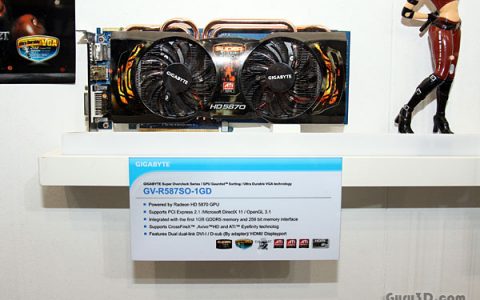
Guru3d has a roundup of their coverage of the CEBIT trade show. They uncover several interesting graphics cards, including a Radeon HD 5770 from PowerCooler with 5 DisplayPorts. This is a step down from the Eyefinity version using the Radeon HD 5870, but it should also be less expensive. One of their most interesting finds came from the Gigabyte booth where they found the following:

Here we see the upcoming high-end R587SO. GV-R587SO-1GD running apparently at 1000/5200 MHz. Thus, this is second after MSI series Radeon HD 5870, which promises to work at the core frequency 1 GHz. This video card will appear late March. The PCB uses Gigabyte's Ultra Durable VGA construction which makes use of a PCB with 2 oz copper layer, ferrite core chokes, low RDS (on) MOSFETs, and Japanese solid-state capacitors. The VGA cooler consists of a GPU base from which four copper heat pipes convey heat to aluminum fin blocks cooled by two 90 mm fans.

via CeBIT 2010 tradeshow coverage.

Hardware , , ,

 
Stories from March 5th, 2010

CEBIT Coverage at Hardware Heaven

HardwareHeaven has been at Cebit this past week, and has written up their coverage of what you could have seen (had you been there) in each of the booths they visited. Of particular interest is what they wrote about in NVidia’s booth. Take a look at the image to the right. NVidia has three monitors running a video game. Do the graphics look at bit fuzzy to you? Well, there is a reason for that, and I will let them tell you about it.

Nvidia’s ultra-secure location provided us with probably the most interesting meeting of the day. In one room they had a GTX 480 SLI system up and running, connected to 3 1080p screens powering Need For Speed Shift (in 3D). Next door, a similar system was running Bad Company 2 on the same display configuration. In a third room were numerous boxes running single GTX 480 cards. We are glad to report that the room was not burning down and that it didn’t sound like a wind tunnel which is great…

I am not certain how well 3-D will work across 3 monitors with the bezels. Still I want to encourage you to visit their site since they have a really good write-up for each of the different vendors.

via : HardwareHeaven at Cebit 2010 – Day One
via : HardwareHeaven at Cebit 2010 – Day Two

Hardware , , , , ,

 
Stories from March 3rd, 2010

GeForce 480 at CEBIT


On March 26, NVidia will be releasing the GeForce GTX 480 and 470. Rumor is that it is 5% faster than the Radeon HD 5870. Rumor also has it that availability will scarce for the first couple of months. At CEBIT this week, Tweakers.net took some photos of the, as yet unreleased, graphics card. Guru3D provides the following commentary on the images:

We spot 12 memory chips which are on a 384-bit wide memory interface. The GPU is powered by a 6-phase vGPU circuit then we spot a 2-phase Memory circuit. Power is drawn from an 8-pin and a 6-pin power connector. Monitor connectivity shows two DVI-D, and a mini HDMI connector.

via : Tweakers.net
via : CEBIT 2010 – GeForce GTX 480 PCB photo

Hardware , , , , , ,

 
Stories from February 25th, 2010

AMD Radeon HD 5830 Review

[H]ard|OCP reviews the AMD Radeon HD 5830 which we have talked about over the past few days. The 5830 is to have 1120 unified shaders running at 800 MHz, 56 texture mapping units, 16 render output units, and 1 GB of GDDR5 memory running at 1 GHz. The suggested retail price is $239. It appears, however, that this is a paper launch, and that the 5830 will not show up until next week. Right now, I cannot find any 5830 graphics cards for sale at NewEgg.com. How does it perform? We will let the article answer that question.

The Radeon HD 5830 is simply positioned perfectly between the Radeon HD 5770 and Radeon HD 5850 in performance. In all three games we tested, we found that it fits well in-between these two video cards performance wise. It delivers a gaming experience that is superior to the Radeon HD 5770. If the performance of the Radeon HD 5770 is just not enough for you, the Radeon HD 5830 will offer big improvements in every game.

via AMD’s ATI Radeon HD 5830 Review | [H]ard|OCP.

Hardware , , ,

Radeon HD 5870 Eyefinity-6

As we have reported before, on March 11, AMD will launch its Radeon HD 5870 Eyefinity6 edition with 2GB of GDDR5. This extra memory is needed to handle the larger framebuffer when you are running in 6 monitor mode. In all other respects, such a clock and memory speeds, the card is exactly a stock 5870. Today, AnandTech has posted more information on the new graphics card.

Since this is still being driven by Cypress, the clock source limitation has not changed. Cypress only has 2 clock sources for DVI-type displays, so the 5870E6 can only drive up to 2 DVI/HDMI displays using passive adapters. Furthermore if you want to drive a 2560 display or a 120Hz 1920 display, you’re going to need active adapters regardless of clock sources. So if you’re thinking of buying this as a 2GB 5870 to drive your 2560 DVI monitor, you’re still going to be shelling out another $100 for an active adapter. Even with the dongles, it’s clear that this card really is meant to be paired with DP/mini-DP monitors for the long-run.

The Dell 3008WFP is a 30 inch monitor with a resolution of 2560 x 1600, and it accepts DisplayPort signal inputs. Thus if I want to drive six of these monitors, then I will need to add in six active adapters, at least as I understand it.

via AnandTech: AMD’s Radeon HD 5830: A Filler Card at the Wrong Price.

Hardware , , ,

 
Stories from February 24th, 2010

Radeon HD 5830 GPU launches tomorrow

New details have emerged about the AMD Radeon HD 5830. The Radeon HD 5830 GPU was to have launched on January 25, 2010. As we reported earlier, the reason for the delay was that a problem on the circuitboard was triggering an error when it underwent testing. Now more details about the 5830 have been revealed. The 5830 is to have 1280 1120 unified shaders running at 750 800 MHz, 64 56 texture mapping units, 32 16 render output units, and 1 GB of GDDR5 memory running at 1 GHz. As a comparison, the more expensive 5850 has 1440 unified shaders running at 725 MHz, and 1 GB of GDDR5 memory running at 1 GHz. You will notice the specifications have changed since we last talked about the 5830, and they have not changed for the better. Meanwhile, the 5850 sells for about $310 on NewEgg (all the $300 ones are back-ordered).

via : Radeon HD5830 details leak

Hardware , , ,

VizWorld.com is a production of VizWorld, LLC © 2009